Stop Asking What Will Happen. Ask This Instead.
By Grace
Table of Contents
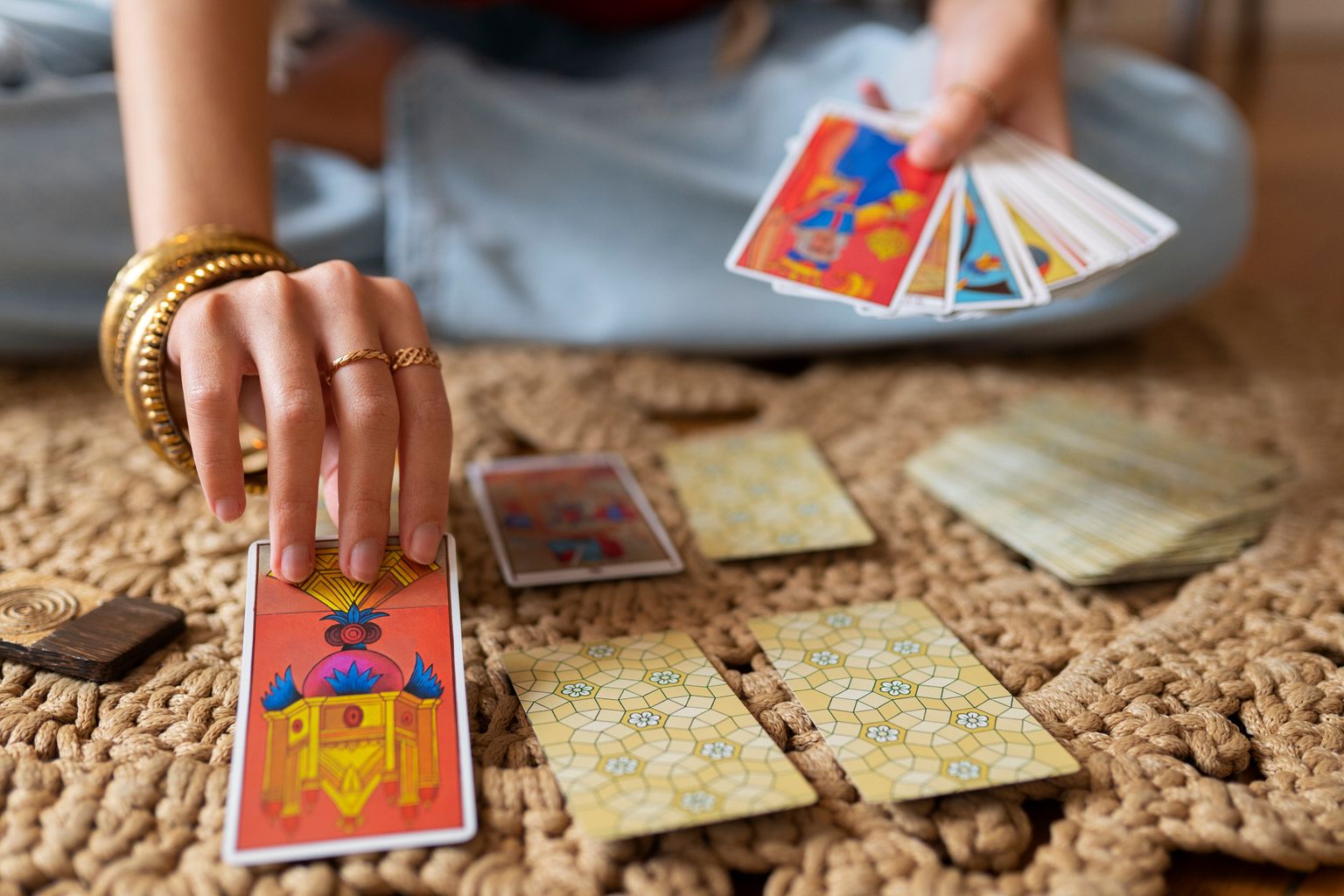
If I had a dollar for every time someone said “so, can you tell me what’s going to happen next week?” when tarot came up in conversation, I’d probably have enough for a really nice dinner. It’s the number one thing people assume about tarot. That it’s a crystal ball. That someone flips a few cards and suddenly knows whether you’ll get the job, meet the love of your life, or win the lottery.
I get why people think that. Movies and TV have done a great job of painting tarot as this mystical fortune-telling thing where a dramatic woman in a dark room reveals your destiny. It makes for great television. But it’s about as accurate as thinking all scientists wear lab coats and shout “eureka” every five minutes.
So let’s clear this up. Here’s what tarot actually is, and why the reality is honestly way more interesting than the myth.
What people think tarot does
Most people who haven’t experienced tarot firsthand tend to picture something like this:
- You sit down with a reader who shuffles some cards
- They flip them over and tell you what’s going to happen in your love life, career, or finances
- You walk away with a prediction that either comes true or doesn’t
- The whole thing is basically a more aesthetic version of a horoscope
And look, there’s no shame in thinking that. It’s what pop culture has been telling us for decades. But this version of tarot misses the entire point of what makes it genuinely valuable.
What tarot actually does
Here’s the part that surprised me when I first started exploring tarot. Instead of giving you answers about the future, it asks you questions about the present. Really good questions. The kind you’ve probably been avoiding.
A tarot reading, at its core, is a structured conversation with yourself. The cards don’t predict what’s coming. They reflect what’s already happening. Your patterns, your feelings, the things you know deep down but haven’t said out loud yet.
Think of it like this. Imagine you’ve been stressed about a decision for weeks. You’ve gone back and forth, made lists, asked friends. Then you sit down with a tarot reading and a card comes up that’s all about fear of change. Nobody told you anything new. But suddenly you’re looking at your situation from a different angle, and something clicks.
That’s not fortune-telling. That’s self-reflection with a really effective tool.
5 things tarot is actually great for
If tarot isn’t about predicting the future, what’s it good for? Quite a lot, actually.
-
Getting clarity when you’re overthinking. When you’ve been spinning in circles about a decision, tarot helps you step back and see the bigger picture. It cuts through mental noise in a way that just “thinking harder” never does.
-
Recognizing patterns you didn’t notice. We all have habits, emotional patterns, and default responses that run on autopilot. Tarot has a way of holding up a mirror to those patterns so you can actually see them.
-
Checking in with yourself. Most of us are terrible at this. We check our phones a hundred times a day but almost never pause to ask ourselves how we’re really doing. A tarot reading creates that pause.
-
Processing feelings that don’t have words yet. Sometimes you feel something but can’t quite name it. The imagery and symbolism in tarot gives you a language for those unnamed feelings. It’s like finding the right word for something you’ve been trying to describe for months.
-
Making better decisions. Not because the cards tell you what to choose. But because when you understand yourself more clearly, your decisions naturally improve. You stop choosing from fear or habit and start choosing from a more grounded place.
Why the “no predictions” thing is actually better
I know, I know. Part of you probably wishes tarot could just tell you what’s going to happen. Life would be so much simpler if someone could flip a card and say “yes, take the job” or “no, don’t text them back.”
But think about it for a second. Even if someone could predict your future, would that actually help you grow? Would it make you more confident in your own judgment? Or would it just make you dependent on external validation for every decision?
The beauty of tarot being a reflection tool rather than a prediction tool is that it puts the power back where it belongs: with you. You’re not handing over your agency to a deck of cards. You’re using those cards to access wisdom you already have but might not be listening to.
There’s something genuinely empowering about sitting with a reading and realizing that the insight didn’t come from the cards. It came from you. The cards just helped you hear it.
But does it actually work?
Here’s my honest answer. Tarot works if you’re willing to be honest with yourself. That’s it. There’s no magic password, no special belief system required. You don’t have to be spiritual or mystical or anything in particular. You just have to be open to looking at yourself with curiosity instead of judgment.
Some people find that tarot resonates with them on a deep level. Others find it useful as a practical thinking tool, nothing more. Both of those experiences are completely valid. The point isn’t what you believe about how it works. The point is whether the process of reflection helps you understand yourself a little better.
And for most people who give it a real chance, it does.
So what’s the takeaway?
Tarot isn’t about someone telling you what’s going to happen. It’s about creating a space where you can hear what you already know. It’s a mirror, not a crystal ball. And that distinction matters, because a mirror is something you can use every day. A crystal ball is just a novelty.
If you’ve been curious about tarot but held back because the fortune-telling angle felt a bit too “out there” for you, this might be worth exploring. You don’t need to believe in anything supernatural. You just need to be willing to sit with yourself for a little while and see what comes up.
You might be surprised by what’s already there, waiting to be noticed.
Also try one of these readings